I thought I understood how buying stocks worked until I made one very expensive mistake.
I had ₦5 million ready to invest and I was excited because I believed I was finally taking a serious step into the Nigerian stock market. I had found the stock I wanted to buy, opened my broker app, checked the price on my screen and prepared to place the order. At the time, I thought the process was straightforward. I could see the current price, I had the money in my account and I simply needed to tell the broker to buy the shares.
The mistake I made was using a market order without properly understanding how it would be executed.
I assumed that when my screen showed a particular share price, that was the price I would pay for the entire order. That assumption turned out to be wrong. The experience taught me one of the most important lessons I now consider whenever I am buying a large number of shares: the price you see on your investment app is not necessarily the price at which your entire order will be executed.
If you are new to investing, this may sound like a small technical detail. It is not. When you are buying a few shares, the difference may not be significant. But when you are placing an order worth hundreds of thousands or millions of naira, even a relatively small movement in the execution price can have a meaningful effect on the amount you spend.
That is why I want to explain what happened, what a market order really means, what an order book shows you and why understanding the difference between a market order and a limit order can help you avoid an expensive mistake.
What Is a Market Order?
A market order is an instruction to your broker or trading platform to buy or sell a stock at the best available price in the market at the time the order is executed.
The important words here are best available price.
A market order does not normally mean, “Buy this stock at exactly the price currently displayed on my screen.” Instead, it means that you want the trade executed using the available orders in the market.
This distinction becomes important when there are not enough shares available at the price you expected.
Imagine that a stock is showing around ₦100 and you want to buy ₦5 million worth of it. You might look at your screen and think that you are about to buy approximately 50,000 shares at ₦100 each.
But what happens if there are only 5,000 shares available from sellers at ₦100?
Your order still needs to find the remaining shares.
The trading system may therefore move to the next available selling price. Perhaps another seller is offering shares at ₦101. Another seller may be asking ₦102. Another may be asking ₦103.
Your order can therefore be filled across several different prices.
This is one of the things I did not properly understand when I placed my first large order.
I was looking at one number on my screen when the market was actually made up of many different buyers and sellers willing to transact at different prices.
The Bamboo Order Book Makes This Much Easier to Understand
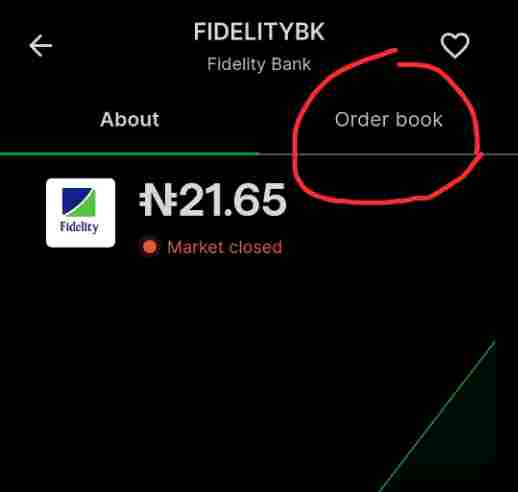
This is where the Order Book feature on Bamboo becomes particularly useful for explaining what happens behind the price displayed on a stock page.
On Bamboo, when you open a stock such as Fidelity Bank, you can switch from the main information page to the Order Book. The Order Book provides a view of some of the current buying and selling interest for the stock.
In the above screenshot we are using for this article, Fidelity Bank is displayed at ₦21.65 on the main stock page.
At first glance, someone who wants to buy the stock might simply look at ₦21.65 and assume that this is the price at which they can buy their shares.
However, when the Order Book is opened, the picture becomes much clearer.
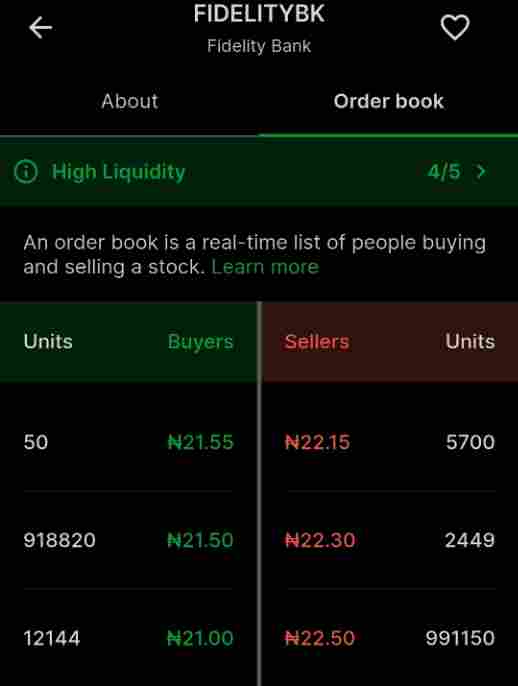
On the buyers’ side, the screenshot shows buyers offering prices such as ₦21.55, ₦21.50 and ₦21.00. On the sellers’ side, the displayed selling prices include ₦22.15, ₦22.30 and ₦22.50, with different numbers of shares available at each price.
This is a very important lesson for a new investor.
The ₦21.65 displayed on the stock page does not mean that someone placing a large market order can necessarily buy every share at ₦21.65. The Order Book is showing that buyers and sellers are currently placing orders at different prices.
That is the information you need to understand before placing a large trade.
What Does the Order Book Actually Mean?
Think of the Order Book as a window into the buying and selling interest currently available for a stock.
The Buyers section shows prices at which buyers are willing to buy. The Sellers section shows prices at which sellers are willing to sell. The Units column tells you how many shares are associated with the displayed order at that particular price.
Using the Fidelity Bank screenshot as an illustration, the sellers shown include 5,700 shares at ₦22.15, 2,449 shares at ₦22.30 and 991,150 shares at ₦22.50.
These figures are not a promise that these shares will remain available until you place an order. The market can change very quickly. Someone can cancel an order, another investor can place a new order or another trade can take some of the available shares.
That is why an Order Book should be treated as a snapshot of available market interest rather than a guarantee of what will happen when you eventually press the buy button.
Still, it gives you information that the headline stock price alone cannot provide.
Now Imagine You Want to Buy 10,000 Fidelity Bank Shares
Let us use the screenshot to understand why this matters.
Suppose, purely for illustration, that you want to buy 10,000 Fidelity Bank shares and the displayed sell orders remain exactly as shown in the screenshot.
The first 5,700 shares could potentially be matched against the seller offering shares at ₦22.15. That would not be enough to complete your 10,000 share order, so the remaining shares would have to be matched against other available sellers.
The next displayed selling level is ₦22.30, where 2,449 shares are shown. After those shares are taken, you would still need another 1,851 shares. The next displayed level is ₦22.50.
This simple example shows why a large market order can be executed at more than one price.
Related Content




You may have entered the trade thinking about one price, but the actual transaction can involve several prices depending on the available liquidity.
This is also why I would not tell a new investor to look only at the large number displayed beside the stock name. Before placing a large order, you need to understand what is actually available in the market.
What Is Slippage?
This brings us to something every serious investor should understand: slippage.
Slippage is the difference between the price you expected when placing an order and the actual price at which the trade is executed.
It can happen for different reasons, including changes in the market, limited liquidity and differences between available buy and sell orders.
For example, imagine you see a stock at ₦100 and expect to spend approximately ₦1 million buying 10,000 shares. If there are enough sellers at or around ₦100, your execution may remain close to your expectation.
But suppose there are only 2,000 shares available around ₦100 and the remaining sellers are asking ₦101, ₦102 and ₦103. A large market order could move through those different price levels as it searches for enough shares to complete the transaction.
The result is that your average purchase price could be higher than the price you originally saw.
This becomes much more important when you are dealing with a large amount of money.
If you are investing ₦20,000, a small difference in execution may not have a major effect on your overall position. If you are investing ₦5 million, the same concept can become much more significant.
That was one of the lessons my own experience taught me.
Why the Price on Your App May Not Be the Price You Receive
There is another important point that new investors often overlook.
A stock app can display a price that represents a recent trade, a reference price or another market price depending on how the platform presents its data. That does not automatically mean that you can buy an unlimited number of shares at exactly that price.
The market consists of buyers and sellers.
If someone is willing to sell only 1,000 shares at a particular price, you cannot assume that 100,000 shares are available at that same price simply because the stock page displays that number.
This is why the Order Book can be useful.
It helps you see the difference between the headline price and the actual buying and selling interest shown at different price levels.
For investors placing larger orders, that information can be extremely valuable.
Market Order vs Limit Order

The other major lesson I learned is the importance of understanding limit orders.
With a market order, your main instruction is essentially to execute the trade at the best available prices.
With a limit order, you specify the maximum price you are willing to pay when buying a stock.
For example, suppose you want to buy a particular stock but decide that ₦100 is the highest price you are willing to pay. You can place a limit order at ₦100.
If there are sellers willing to sell at ₦100 and your order is matched, the purchase can take place at that price or a better available price according to the market and order matching rules.
However, if there are no sellers willing to sell at ₦100 or below, your order may not be completed.
And this is the trade off.
A market order generally gives you a higher priority on getting the trade executed, but you have less control over the exact price.
A limit order gives you greater control over the price you are willing to accept, but there is no guarantee that your entire order will be filled.
Neither order type is automatically better in every situation. The right choice depends on what you are trying to achieve, the stock you are trading, the liquidity available and the size of your order.
Why Liquidity Matters When You Are Buying Stocks
Liquidity is another word investors should understand before putting a large amount into a stock.
A highly liquid stock generally has more buying and selling activity, making it easier to transact without causing a large movement in price.
A stock with lower trading activity may have fewer shares available at each price level.
This means a person trying to buy a large number of shares may have a harder time getting the entire order filled at one price.
That is why two stocks with the same displayed price can behave very differently when you try to invest a large amount.
For example, Stock A may be trading at ₦50 with thousands or millions of shares changing hands regularly. Stock B may also be trading at ₦50 but have very little activity.
If you try to buy ₦5 million of both stocks, the execution experience may be completely different.
The price alone does not tell you everything.
Liquidity, trading volume and the available orders matter.
What I Would Do Differently Today
If I were placing that first ₦5 million investment again, I would not simply open the app, look at the displayed share price and immediately submit a large market order.
I would first understand the stock’s current trading activity. I would look at the Order Book where the platform provides it and examine the available buying and selling prices. I would consider how many shares are available around the price I am targeting and think about whether my order is large enough to move through several price levels.
I would also decide beforehand how much I am actually willing to pay.
If controlling the maximum purchase price was more important to me than getting the entire order executed immediately, I would consider using a limit order.
I would also avoid putting a very large amount into a trade before becoming familiar with how the particular broker or investment platform handles orders. Every investor should understand what happens after they press the buy button, not discover it after committing millions of naira.
Do Not Confuse the Order Book With a Guarantee
There is one thing I want to make very clear about the Bamboo screenshot used in this article.
The prices and units displayed in an Order Book can change.
The screenshot is therefore an educational example, not a promise that an investor will receive those exact prices. The available orders may change before an investor places a trade, and other investors may buy or cancel the shares shown.
This is important because financial education should not create false expectations.
The purpose of the screenshot is simply to show you that a stock can have multiple buying and selling prices at the same time, and that the price displayed on the main stock page does not tell the whole story about available liquidity.
A Simple Example With ₦5 Million
Let us bring everything together with a simple example.
Suppose you have ₦5 million and want to buy a stock trading around ₦100.
You might initially calculate that ₦5 million divided by ₦100 gives you approximately 50,000 shares.
But before placing the order, you check the Order Book and discover that only a small number of shares are available around ₦100. Other sellers are asking ₦101, ₦102 and ₦103.
If you use a market order, the system may continue matching your order with available sellers until the required quantity is reached, subject to the market’s order matching process.
Your final average purchase price could therefore be higher than ₦100.
If you instead place a limit order at ₦100, you are saying that you do not want to pay above your chosen limit. The downside is that if there are not enough sellers at ₦100 or below, some or all of your order may remain unfilled.
That is the decision investors need to understand.
Do you care more about getting the order filled, or do you care more about controlling the maximum price?
Once you understand that question, market orders and limit orders become much easier to understand.
Mistakes New Stock Investors Should Avoid
One mistake is assuming that the price displayed on an app is automatically the price you will pay for every share in a large order. Another is ignoring the Order Book when buying a stock with limited trading activity. Some investors also rush into a market order because they see a stock price rising and fear missing the opportunity.
That can be dangerous because a rising price can make investors act emotionally instead of carefully considering the order they are about to place.
Another mistake is putting a large amount of money into a stock without first understanding the trading platform. Before investing significant money, learn how the platform displays prices, how it presents the Order Book, how orders are submitted and what happens when there are not enough shares available at the price you expect.
Most importantly, never invest money simply because someone online says that a stock is going up.
Understanding how an order works is only one part of investing. You still need to understand the company, its financial statements, valuation, risks, business model, earnings and long term prospects.
What I Want New Investors to Remember
The biggest lesson from my experience is not that market orders are bad.
It is that you should never use an investment tool that you do not understand.
A market order can be useful. A limit order can also be useful. The important thing is knowing what each one does before you commit your money.
If you are buying a small amount of a highly liquid stock, the difference may not matter much to you. If you are placing an order worth hundreds of thousands or millions of naira, however, understanding the available prices and liquidity becomes much more important.
The next time you open your investment app and see a stock price, do not immediately assume that you can buy any quantity you want at that exact price.
Ask yourself: What are sellers actually offering? How many shares are available? How active is this stock? What is my maximum acceptable price? Am I using a market order or a limit order?
Those questions take only a few minutes to answer.
They could save you from a very expensive lesson.
I learned mine with money.
You do not have to learn yours the same way.
Frequently Asked Questions
What is a market order?
A market order is an instruction to buy or sell a stock at the best available prices when the order is executed. The final execution price may differ from the price displayed when the order was placed, particularly when the order is large or the stock has limited liquidity.
What is a limit order?
A limit order allows an investor to specify the maximum price they are willing to pay when buying a stock or the minimum price they are willing to accept when selling. The trade may remain unfilled if the market does not reach the specified price.
What is an Order Book on Bamboo?
The Order Book on Bamboo shows available buying and selling interest for a stock, including displayed prices and the number of units associated with those orders. It can help investors understand the different prices at which buyers and sellers are currently willing to transact.
Why is the stock price different from the prices in the Order Book?
The main stock price displayed by an investment platform does not necessarily represent an unlimited quantity of shares available at that exact price. The Order Book can show different buying and selling prices and the number of shares associated with them.
Can a market order be executed at different prices?
Yes. A sufficiently large market order may be matched against multiple available selling or buying prices, depending on the size of the order and the liquidity available in the market.
What is slippage in stock trading?
Slippage is the difference between the price an investor expects when placing an order and the actual execution price. It can occur when available liquidity changes or when there are insufficient shares at the expected price.
Is a limit order safer than a market order?
Neither order type should automatically be described as safer. They serve different purposes. A market order prioritises execution at available prices, while a limit order gives the investor more control over the price but does not guarantee execution.
Should I check the Order Book before buying a large amount of stock?
It can be useful, particularly when placing a large order or trading a stock with lower liquidity. The Order Book can help you understand the buying and selling prices currently displayed in the market before you submit your order.
Conclusion
My first experience with a large stock purchase taught me something that no amount of excitement about investing could replace: knowing what you are buying is not enough. You also need to understand how your order will reach the market and how the price can change during execution.
The Nigerian stock market offers opportunities for investors, but investing successfully requires more than finding a company you like and pressing the buy button. You need to understand prices, liquidity, order types, risk and your own investment objectives.
If you are just starting, take your time. Learn how your broker works. Look at the Order Book when it is available. Understand the difference between a market order and a limit order. Start with an amount you are comfortable learning with before committing a much larger sum.
The goal is not to become afraid of investing.
The goal is to become an informed investor.
And if my expensive mistake can help another investor avoid making the same mistake with their first ₦1 million, ₦5 million or even ₦50,000 investment, then at least something valuable came out of it.