Many OPay users, POS merchants, and business owners woke up on January 14, 2026, to a strange debit alert that caused fear and confusion across Nigeria. Several users noticed a ₦1,000 debit or similar amounts on their OPay accounts, described as “Stamp Duty Charge on 20 Transactions from Jan 1st, 2026 to Jan 4th, 2026.”
This sudden deduction led to panic calls, especially from merchants, because people believed OPay or banks had started deducting stamp duty twice.
This article explains exactly what happened, why it happened, and why the ₦50 stamp duty will NOT be deducted twice.
What Changed With Stamp Duty in January 2026?
Effective January 1, 2026, the Central Bank of Nigeria (CBN), in line with the new tax reform, renamed the ₦50 Electronic Money Transfer Levy (EMTL) as Stamp Duties.
This means that from January 2026:
- The ₦50 charge did not stop
- Only the name changed
- It now appears as “Stamp Duties” on POS terminals and banking apps, including OPay
So when you see “Stamp Duties” on your transaction history, it is not a new charge. It is the same ₦50 levy Nigerians have been paying for years, only under a new name.
The Major Change People Must Understand Clearly
Before January 2026, whenever someone transferred ₦10,000 or more, the ₦50 stamp duty was deducted from the receiver of the money.
This confused many people because:
- You receive money
- Yet ₦50 is removed from your balance
- Even though you did not initiate the transfer
That system has now changed.
From January 2026, the ₦50 stamp duty is now deducted from the sender, not the receiver.
So if you are the one sending ₦10,000 or more:
- You pay the normal ₦20 transfer charge
- You also pay the ₦50 stamp duty
- Total possible charge becomes ₦70
This change is very important, especially for POS operators and merchants.
Related Content





When Did the Actual Deduction Start?
This is where the confusion started.
Although the policy took effect from January 1, 2026, most banks and fintech platforms, including OPay, did not start deducting the stamp duty immediately.
In reality:
- Transfers from January 1 to January 4, 2026, went through without the ₦50 stamp duty being deducted from the sender
- The system adjustment was completed later
- Active deduction effectively started around January 5, 2026
So there was a gap period where transactions that should have attracted stamp duty were not charged.
Why Did CBN Deduct the ₦50 in Bulk on January 14, 2026?
OPay did not invent a new charge.
What happened is simple.
Once the system was fully updated, OPay:
- Reviewed transactions made between January 1 and January 4, 2026
- Counted how many transfers of ₦10,000 and above were made during that period
- Calculated the ₦50 stamp duty for each qualifying transaction
- Deducted them once, in bulk
That is why some users saw descriptions like:
“Stamp Duty Charge on 20 Transactions from Jan 1st, 2026 to Jan 4th, 2026 – ₦1,000”
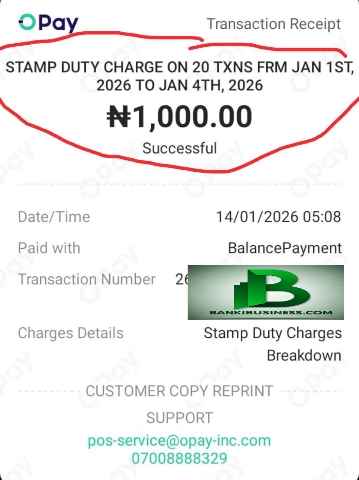
₦50 × 20 transactions = ₦1,000
No extra charge was added.
Why This Is NOT Double Deduction
Many people are afraid that:
- The ₦50 was deducted later
- And may still be deducted again per transaction
That fear is understandable, but it is not correct.
Here is the clear explanation:
The ₦50 deducted on January 14 covers:
- Only transactions that happened before the system started charging
- Only transactions that were missed earlier
- Each transaction was charged once
After that bulk deduction:
- New transfers are charged immediately
- No transaction is charged twice
- There is no repeat calculation
So if a transaction already appeared in that Jan 1–4 calculation, it will not be charged again.
Important Clarification: OPay Is Not Taking the Money
This point must be very clear.
OPay is not the beneficiary of the ₦50 stamp duty.
The money goes directly to the Federal Government, in line with the tax reform and existing stamp duty laws.
OPay, banks, and POS platforms are only:
- Collecting agents
- Required by regulation to remit the funds
So this is not an OPay policy, and it is not unique to OPay.
What This Means for POS Operators and Merchants
This change affects how POS operators charge customers.
Since the ₦50 stamp duty is now deducted from the sender:
- POS operators who help customers send ₦10,000 or more must factor it in
- Customers must be informed clearly
- Pricing should be adjusted transparently
It is now left to each POS business to decide how to structure charges so that the ₦50 stamp duty does not lead to unexpected losses.
Summary for Everyone Experiencing This Issue
- The ₦50 charge is not new, only renamed to Stamp Duties
- The deduction responsibility moved from receiver to sender
- Transactions from Jan 1–4 were charged later because the system was not active
- Bulk deduction was a correction, not double billing
- Once deducted, it will not be deducted again
- OPay is only complying with government policy
Conclusion
If you saw a sudden ₦1,000 or similar debit today, it does not mean something is wrong with your account. It simply means your earlier qualifying transfers were charged correctly, just at a later date.
Understanding this now will help POS operators, merchants, and customers avoid panic, false accusations, and unnecessary fear.
This is the new reality of stamp duty deductions in Nigeria from 2026.