A Nigerian woman has taken to social media to allege that $118 mysteriously disappeared from her Chipper Cash dollar wallet after a series of card-related charges linked to Google services.
The incident, which has since generated widespread reactions online, has reignited concerns about the security of virtual dollar cards, recurring subscription payments, unauthorized transactions, and the risks associated with digital payment platforms.
According to the woman, she had saved the money in her Chipper Cash dollar account for online transactions but was shocked to discover that almost all the funds had been deducted, leaving only 76 cents in her wallet.
Screenshots she shared showed multiple transaction attempts and charges connected to various Google-related services, prompting questions about whether the deductions were caused by active subscriptions, merchant billing practices, card security issues, or other factors.
As Nigerians increasingly rely on fintech platforms and virtual dollar cards for international payments, the incident has sparked fresh discussions about how users can better protect their funds and monitor online transactions.
The woman, identified on Facebook as Jennifer Oamhen Thomas, shared screenshots showing what appeared to be multiple declined transactions linked to various Google services, while lamenting that almost all the money she had saved in her account had disappeared.
According to her post, she had kept $118 in her Chipper Cash dollar wallet because she regularly used the linked ATM card for online transactions.
However, upon checking the account recently, she claimed she discovered that nearly all the funds were gone.
“I left $118 on my Chipper Cash app because I use the ATM card for online transactions. I opened the account last night only to discover that they have debited all the money out, leaving just 76 cents. I am so pained,” she wrote.
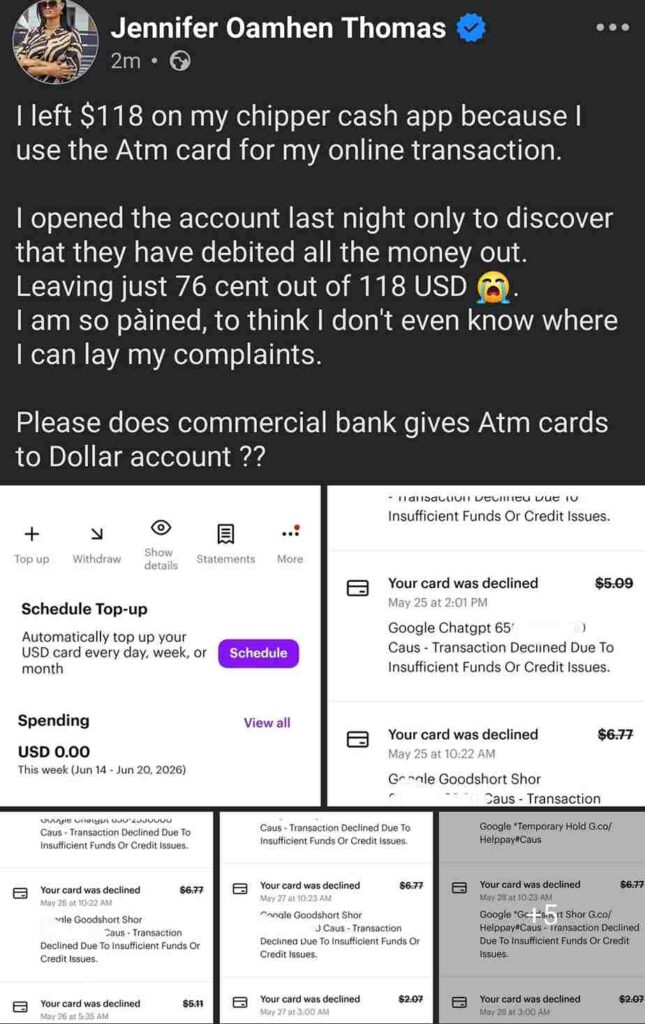
The woman further stated that she was unsure where to direct her complaint and asked whether commercial banks in Nigeria issue ATM cards for domiciliary (dollar) accounts.
Related Content


The screenshots attached to her post appeared to show several transaction attempts connected to Google-related services, including entries such as “Google ChatGPT,” “Google GoodShort,” and other charges ranging from a few dollars to over $6. Some of the transactions were marked as declined due to insufficient funds or credit issues.
Her post quickly attracted reactions from social media users, many of whom claimed they had experienced similar issues with virtual dollar cards and online subscriptions.
One commenter suggested that recurring online subscriptions may have been responsible for the deductions, while another claimed she abandoned the platform because of similar experiences.

The incident has once again highlighted growing concerns among Nigerians who use virtual dollar cards, fintech wallets, and international payment solutions for online purchases, subscriptions, advertising payments, and foreign transactions.
Why Money May Disappear From a Dollar Card Wallet
Financial experts note that unauthorized deductions are not always the result of hacking or fraud. In many cases, users unknowingly authorize recurring payments when signing up for online services.
Common reasons money may leave a dollar card include:
1. Recurring Subscriptions
Many online platforms automatically renew subscriptions after free trials or monthly plans expire. These include streaming services, AI tools, cloud storage services, educational platforms, and mobile applications.
If users forget to cancel these subscriptions, charges can continue automatically.
2. Card Details Stored on Multiple Platforms
When a card is linked to several websites or apps, merchants may attempt to process payments periodically, especially if previous transactions were authorized.
3. Temporary Authorization Holds
Some online merchants place temporary verification charges on cards to confirm validity before completing transactions. These amounts are usually reversed, but they can sometimes create confusion among users.
4. Compromised Card Information
If card details become exposed through phishing websites, fake applications, suspicious links, or data breaches, fraudsters may attempt unauthorized transactions.
5. Merchant Billing Errors
In some situations, duplicate charges or billing mistakes can occur, requiring users to contact customer support for investigation and possible refunds.
Understanding Virtual Dollar Cards
Virtual dollar cards have become increasingly popular in Nigeria due to restrictions on international spending using naira cards.
These cards allow users to:
- Pay for online subscriptions
- Shop on international websites
- Pay for digital advertising
- Purchase software and digital services
- Make foreign currency transactions
While convenient, experts advise users to regularly monitor transaction histories, activate spending notifications, and avoid leaving large amounts of money in wallets that are not actively being used.
How Users Can Protect Their Dollar Wallets
To reduce the risk of unexpected deductions, financial analysts recommend the following:
- Enable instant transaction alerts.
- Regularly review card statements.
- Remove cards from services no longer in use.
- Use separate cards for subscriptions.
- Freeze or lock cards when not needed.
- Avoid sharing card details on untrusted websites.
- Report suspicious transactions immediately.
Can Nigerian Banks Issue ATM Cards for Dollar Accounts?
Yes. Many Nigerian banks offer domiciliary accounts that may come with international debit cards, subject to the bank’s policies, eligibility requirements, and applicable fees.
Customers interested in obtaining a dollar-denominated card are advised to contact their preferred bank directly to confirm current offerings, charges, spending limits, and card availability.
Growing Need for Consumer Awareness
As digital payments continue to grow across Nigeria and Africa, financial experts say users must become more vigilant about how their cards are used online.
The viral complaint serves as a reminder that while virtual dollar cards provide access to global payments, they also require careful monitoring to avoid unexpected charges, recurring subscriptions, and potential security risks.
Whether the deductions in this case resulted from subscriptions, authorization attempts, billing errors, or unauthorized transactions remains unclear. However, the incident has reignited conversations about digital payment security and the importance of closely tracking every transaction linked to online payment cards.