Choosing the best bank for daily banking is an important financial decision. Your bank account is where your paycheck may arrive, where you pay bills, withdraw cash, send money, receive transfers and make everyday purchases.
That means the right bank should do more than simply keep your money. It should make your everyday banking easy, affordable and reliable.
A bank may look attractive because it offers a cash bonus or a high promotional rate, but that does not necessarily make it the best choice for everyday banking. A checking account with a monthly fee, expensive out-of-network ATM charges or an inconvenient mobile app can cost you more over time.
The good news is that comparing banks does not have to be complicated.
The best way to choose is to look at the things you will actually use: monthly fees, ATM access, overdraft policies, direct deposit, mobile banking, branch availability, customer service, account requirements and FDIC insurance.
The FDIC itself recommends comparing the costs, requirements and features of bank accounts before opening one.
What Makes a Bank Good for Daily Banking?

A good everyday bank should make routine financial tasks simple.
For most people, that means being able to:
- Receive direct deposits without unnecessary fees
- Pay bills easily
- Use a debit card for everyday purchases
- Find convenient ATMs
- Transfer money quickly
- Check balances from a phone
- Deposit checks without visiting a branch
- Get help when there is a problem
- Avoid unnecessary monthly account fees
- Keep money in an FDIC-insured deposit account
The most important point is this: do not choose a bank based on one attractive feature.
Look at the entire account.
For example, a bank may offer a $300 sign-up bonus, but if you cannot meet its direct-deposit requirements or the account charges a monthly maintenance fee after the introductory period, the bonus may not be as valuable as it first appears.
1. Start With the Monthly Maintenance Fee
The first thing I would check when comparing banks is the monthly account fee.
Some checking accounts have no monthly maintenance fee. Others charge a monthly fee but allow customers to avoid it by meeting certain requirements.
Common requirements include:
- Receiving qualifying direct deposits
- Maintaining a minimum balance
- Making a certain number of transactions
- Maintaining other accounts with the same bank
The Consumer Financial Protection Bureau says banks and credit unions can charge monthly maintenance fees, but they must disclose the fee and the conditions attached to it.
This is why you should not stop reading when you see “$0 monthly fee.”
Check whether there are conditions.
For example, suppose a bank says its checking account has no monthly fee if you receive $500 in direct deposits each month. If your circumstances change and you no longer receive that deposit, the account could become less attractive.
A genuinely useful comparison therefore looks at both the advertised fee and how easy it is for you to avoid it.
A simple question to ask
Before opening the account, ask:
What would I have to do every month to pay $0 in account fees?
If the answer is simple and fits your normal banking habits, that is a positive sign.
2. Check the ATM Network
ATM access matters more than many people realise.
If you regularly withdraw cash, a bank with few convenient ATMs can become expensive and frustrating.
Check:
- How many ATMs are available?
- Are there ATMs near your home, school or workplace?
- Does the bank belong to a large ATM network?
- Does it reimburse fees from other ATM operators?
- Are there limits on ATM fee reimbursements?
- Is there a fee for using an out-of-network ATM?
The FDIC specifically recommends checking both your bank’s ATM fees and the charges that may apply when you use another institution’s ATM.
This can make a big difference if you withdraw cash frequently.
For someone who rarely uses cash, ATM access may not be a major deciding factor.
For someone who withdraws cash several times a week, it could be one of the most important factors.
3. Look Carefully at the Overdraft Policy
Overdraft fees can turn an otherwise inexpensive checking account into an expensive one.
An overdraft happens when you do not have enough money in your account to cover a transaction but the bank pays it anyway. The bank may then charge an overdraft fee.
When comparing banks, find out:
- Does the account offer overdraft protection?
- How much can an overdraft cost?
- Can you opt out of debit-card and ATM overdraft coverage?
- Can you link your checking account to savings?
- Does the bank offer another way to cover a temporary shortfall?
- Does the bank charge an NSF fee when a transaction is returned?
The CFPB says customers generally must opt in before a bank can charge overdraft fees on ATM withdrawals and one-time debit-card transactions. However, different rules can apply to checks and recurring electronic payments.
This is one reason you should read the actual account terms instead of assuming that every checking account works the same way.
Consider a low-risk checking account
Some banks offer accounts designed to prevent overdrafts altogether.
With these accounts, a transaction may simply be declined when you do not have enough money rather than allowing the account to go negative and charging an overdraft fee. The trade-off is that these accounts may have fewer features or other restrictions.
For someone who wants strict control over spending, that type of account may be worth considering.
4. Make Sure Direct Deposit Works for You
If your paycheck or other regular income will be deposited into the account, check the bank’s direct-deposit requirements.
Some banks use qualifying direct deposits as a way to waive monthly fees or unlock certain account benefits.
Find out:
- What counts as a qualifying direct deposit?
- Is there a minimum amount?
- How often must the deposit arrive?
- Does direct deposit remove the monthly maintenance fee?
- When will your money become available?
Do not assume that every electronic transfer qualifies as a direct deposit.
If avoiding a monthly fee depends on direct deposit, you want to understand the bank’s exact requirements before opening the account.
5. Compare the Mobile Banking App
For daily banking, your bank’s mobile app may be more important than its branch network.
Think about how often you will use your phone to:
- Check your balance
- Transfer money
- Deposit checks
- Pay bills
- Lock or unlock your debit card
- Receive transaction alerts
- Contact customer support
- View statements
- Set up recurring payments
A good banking app should make these tasks straightforward.
You should also look for security features such as transaction alerts, biometric login and the ability to quickly lock a debit card if it is lost.
The FDIC recommends considering alerts and online banking features when selecting a bank account because they can help customers monitor transactions and manage their money.
Related Content
6. Decide Whether You Need Physical Branches
This is where your personal banking habits become important.
Some people are perfectly comfortable doing almost everything through an app. Others want to be able to walk into a branch and speak with someone.
If you prefer face-to-face banking, check the bank’s branch locations before opening an account.
Look at:
- Branches near your home
- Branches near your workplace
- Branch opening hours
- Saturday availability
- ATM locations
- Services available inside branches
The CFPB also recommends considering branch and ATM availability, opening hours, mobile banking and customer service when comparing banks.
An online bank can be a good choice if you rarely need a branch. But if you regularly deposit cash or prefer speaking with someone in person, physical access becomes much more important.
7. Check the Bank’s Customer Service
You do not think much about customer service when everything is working.
That changes quickly when your debit card stops working, a transaction looks suspicious or your account has been restricted.
Before choosing a bank, find out how customers can get help.
Does the bank offer:
- 24-hour phone support?
- Secure messaging?
- Live chat?
- In-app support?
- Branch assistance?
- A clear process for reporting fraud?
Also consider how easy it is to reach a real person when you have a problem.
A bank can have a beautiful mobile app and excellent fees, but poor customer support can become a serious problem when something goes wrong.
8. Confirm That Your Deposits Are FDIC Insured
This should be near the top of your checklist.
When you keep money in an FDIC-insured bank, eligible deposits are generally insured by the FDIC up to $250,000 per depositor, per insured bank, for each ownership category.
The FDIC recommends checking whether an account is FDIC insured when choosing a bank.
Do not confuse a bank deposit account with an investment product.
FDIC insurance protects eligible deposits at participating banks. It does not mean every financial product offered by a bank is automatically insured.
Before opening an account, verify the bank’s insurance status and understand what type of account you are opening.
9. Look at the Minimum Balance Requirement
A bank account can become inconvenient if you constantly have to worry about maintaining a particular balance.
Some accounts require you to keep a certain amount of money in the account to avoid a monthly fee.
Ask:
What happens if my balance falls below the required amount?
If you are paid twice a month and regularly use your checking account for bills and everyday purchases, maintaining a high minimum balance may not make sense.
A lower-cost account with fewer requirements could be a better fit.
The CFPB notes that minimum balances are among the conditions banks may use to waive monthly maintenance fees.
10. Do Not Ignore Other Bank Fees
Monthly maintenance fees get most of the attention, but they are not the only charges worth checking.
Look at the bank’s fee schedule for:
| Fee | Why it matters |
|---|---|
| Monthly maintenance fee | Can become a recurring cost |
| Out-of-network ATM fee | Important if you use other ATMs |
| Overdraft fee | Can become expensive after a shortfall |
| NSF/returned-payment fee | May apply when certain payments are returned |
| Wire transfer fee | Matters if you regularly send wires |
| Stop-payment fee | Relevant for certain payment situations |
| Cashier’s check fee | Useful to know if you occasionally need one |
| Foreign transaction fee | Important if you make purchases abroad |
| Paper statement fee | Avoidable at many institutions |
Banks are required to disclose applicable account fees and the conditions under which they may be charged.
You do not need a bank that has the lowest price on every possible service.
You need a bank that keeps the services you actually use affordable.
11. Consider Whether the Checking Account Pays Interest
Some checking accounts pay interest, although the rate may be low.
It sounds attractive, but do the maths before choosing an interest-bearing checking account.
The CFPB warns that some interest-bearing checking accounts can come with higher fees or balance requirements. The interest you earn may not compensate for the additional costs.
For everyday banking, I would first make sure the account is affordable and convenient.
Then consider whether earning interest adds meaningful value.
If you normally keep a larger amount of money in cash, it may also be worth comparing a checking account with a separate savings or money market account rather than expecting your everyday account to do everything.
12. Compare Banks Based on How You Actually Bank
This is where choosing the best bank becomes much easier.
Imagine three customers.
Customer 1: The branch customer
This person deposits cash, wants to speak with bank staff and prefers having a branch nearby.
For this customer, branch locations and customer service may matter more than having the highest interest rate.
Customer 2: The mobile banker
This person receives direct deposit, pays bills online, rarely uses cash and does almost everything through a smartphone.
For this customer, a strong mobile app, low fees and easy online support may be more important than branch locations.
Customer 3: The frequent ATM user
This person regularly needs cash.
For this customer, ATM availability and out-of-network ATM fee policies could be more important than a small difference in interest rates.
That is why copying someone else’s bank choice is not always the smartest approach.
Look at your own banking habits first.
A Simple Way to Compare Banks
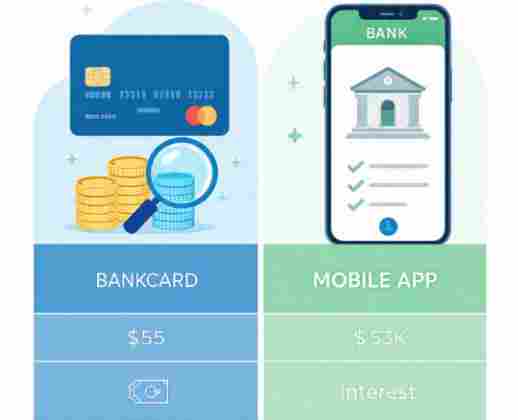
You can make the decision easier by scoring each bank.
For example:
| Feature | Bank A | Bank B | Bank C |
|---|---|---|---|
| Monthly fee | |||
| Fee waiver requirements | |||
| ATM access | |||
| Out-of-network ATM policy | |||
| Overdraft policy | |||
| Direct deposit | |||
| Mobile app | |||
| Branch access | |||
| Customer service | |||
| Other fees | |||
| FDIC insurance | |||
| Overall convenience |
Give each category a score from 1 to 5.
Then give more weight to the features that matter most to you.
For example, if you never visit a branch, do not give branch availability the same importance as mobile banking.
If you withdraw cash regularly, give ATM access more weight.
This approach helps you choose based on real-life usefulness rather than advertising.
Online Bank vs. Traditional Bank: Which Is Better for Daily Banking?
Both can work well.
Online banks
Online banks often compete by offering low fees, strong digital tools and convenient account management.
They can be attractive if you are comfortable doing your banking through an app or website.
The main issue is access.
If you need to deposit cash frequently or want face-to-face assistance, an online-only bank may not be as convenient.
Traditional banks
Traditional banks can offer extensive branch and ATM networks, along with a wider range of financial services.
They may be a better choice for people who value physical locations and in-person support.
However, you should still compare their fees and account requirements rather than assuming a large bank is automatically the better choice.
Should You Choose a Large Bank or a Smaller Bank?
Size should not be the only factor.
Large banks may have extensive branch and ATM networks and a broad range of products.
Smaller banks may offer a more local experience and personalised service.
What matters is whether the bank provides the features you need at a reasonable cost.
The same principle applies when comparing a bank with a credit union. If you are considering a credit union, check its membership requirements and confirm that it offers the services you need.
What to Do Before Opening the Account
Before you submit an application, take a few minutes to read the account disclosures and fee schedule.
Check these questions:
1. What is the monthly fee?
2. How can I avoid it?
3. Is there a minimum balance?
4. What are the ATM fees?
5. Does the bank reimburse out-of-network ATM fees?
6. What happens when I overdraft?
7. Does the account offer mobile check deposit?
8. How does direct deposit work?
9. Are there fees for services I am likely to use?
10. Is the bank FDIC insured?
The FDIC recommends reviewing the account’s features and costs before opening it, while the CFPB advises consumers to compare fees, convenience and account requirements.
A Mistake Many People Make When Choosing a Bank
One of the biggest mistakes is choosing a bank because of a promotion without checking what happens after the promotion.
A $200 or $300 bonus can be useful.
But your checking account may stay with the bank for years.
If you pay a monthly fee, regularly use expensive out-of-network ATMs or struggle with the bank’s account requirements, those costs can eventually outweigh a one-time bonus.
Think beyond the first few weeks.
Ask yourself:
If I kept this account for the next three years, would I still be happy with it?
That is a much better question than simply asking how much money the bank will give you for opening the account.
When Should You Change Banks?
You do not have to stay with a bank simply because you have used it for years.
It may be time to consider another bank if:
- Your monthly fees have become expensive
- Your bank no longer provides the services you need
- ATM access is inconvenient
- Customer service has become difficult
- The mobile app no longer meets your needs
- You regularly pay avoidable fees
- Another bank offers a significantly better account for your situation
The CFPB recommends comparing your existing account’s fees and services with alternatives when considering a change.
Before closing the old account, make sure your paycheck, automatic bills, subscriptions and other recurring transactions have been moved successfully.
The Best Bank for Daily Banking Should Make Your Life Easier
Choosing the best bank for daily banking does not have to be complicated.
Start with the things you will use most.
If you want a simple everyday checking account, prioritise low or no monthly fees, convenient ATM access, a reliable mobile app, easy direct deposit, reasonable overdraft policies, good customer service and FDIC insurance.
If you need branches, make branch access a priority.
If you rarely handle cash, do not pay extra simply for a huge branch network.
If you manage almost everything from your phone, focus heavily on the bank’s digital experience.
And if you frequently use ATMs, pay close attention to the bank’s ATM network and reimbursement policy.
Most importantly, read the fee schedule before opening the account. A bank’s advertisement tells you what it wants you to notice. The account disclosure tells you what you actually need to know.
Final Checklist: How to Choose the Best Bank for Daily Banking
Before choosing your bank, make sure you can answer yes to the questions that matter most to you:
- Does the account have a low or no monthly maintenance fee?
- Can I easily meet the requirements to avoid the fee?
- Are there convenient ATMs where I need them?
- Are out-of-network ATM fees reasonable or reimbursed?
- Does the overdraft policy suit the way I manage money?
- Can I receive direct deposits conveniently?
- Is the mobile app reliable and easy to use?
- Can I deposit checks through the app if I need to?
- Does the bank offer useful alerts and online bill payment?
- Is customer support easy to reach?
- Are branches available if I need them?
- Are the fees for services I use reasonable?
- Is my eligible money protected by FDIC insurance?
If a bank performs well across these areas and fits the way you actually manage your money, you have found a strong candidate for your daily banking needs.
The goal is not simply to find a bank with the most features. It is to find a bank that gives you the services you need, keeps everyday costs under control and makes managing your money easier.
Frequently Asked Questions
What is the most important thing to look for in a bank for daily banking?
For most people, the most important factors are low fees, convenient ATM access, reliable mobile banking, easy direct deposit and good customer service. Your personal banking habits should determine which of these deserves the most weight.
Should I choose a bank with no monthly fee?
A no-monthly-fee checking account can be an excellent choice for everyday banking, particularly if there are no difficult requirements attached. However, check the full fee schedule because an account advertised as free can still have other charges, including certain ATM or overdraft fees.
Is an online bank good for daily banking?
Yes. An online bank can work very well if you are comfortable managing your money through a website or mobile app. It may be less convenient if you regularly need branch services or cash deposits.
Should I choose a bank based on its sign-up bonus?
A sign-up bonus can be valuable, but it should not be the main reason you choose a bank. Compare the account’s ongoing fees, requirements, ATM access and features first.
How do I know if a bank account is safe?
Check whether the bank is FDIC insured and understand what type of account you are opening. Eligible deposits at FDIC-insured banks are generally covered up to the applicable FDIC insurance limits.
What fees should I compare before opening a checking account?
At a minimum, compare monthly maintenance fees, minimum-balance requirements, ATM fees, overdraft or NSF fees, wire fees and other charges for services you expect to use. The CFPB and FDIC both recommend comparing account costs and requirements before choosing an account.