Many Nigerians have taken to social media to question how the Federal Government utilised the reported ₦15.8 trillion generated from the removal of petrol subsidy after Taiwo Oyedele disclosed details of the savings and how the funds were distributed across the country.
The reactions followed comments made by Oyedele, Chairman of the Presidential Fiscal Policy and Tax Reforms Committee, during a media conference where he presented the scorecard of Nigeria’s economic reforms between June 2023 and December 2025.
According to Oyedele, the removal of fuel subsidy and reforms in the foreign exchange market helped mobilise ₦15.8 trillion in additional resources for the federation within the period.
He explained that the increase was largely driven by higher revenue collections and changes in the exchange rate, which raised the naira value of dollar-denominated transactions.
Speaking at the event, Oyedele said the Federal Government received ₦5.4 trillion from the subsidy savings, while states and local governments shared ₦10.4 trillion.
He added that the Federal Government also generated an additional ₦3.1 trillion through independent revenue sources, mainly from remittances by government-owned agencies and enterprises.
According to him, the Federal Government’s total additional resources, including subsidy savings, independent revenue and fresh borrowing, amounted to ₦20.4 trillion during the period under review.
Oyedele noted that without the reforms, the Federal Government would have needed to borrow much more money to fund its activities.
He said the government recorded additional borrowing of ₦11.9 trillion but argued that the figure would have been significantly higher if subsidy removal and foreign exchange reforms had not created more fiscal space.
However, while the government reported increased revenue, many Nigerians on social media expressed concern over the continued economic hardship in the country.
Several commenters questioned why citizens are still struggling with rising food prices, transportation costs and a high cost of living despite the huge amount reportedly saved from subsidy removal.
Related Content


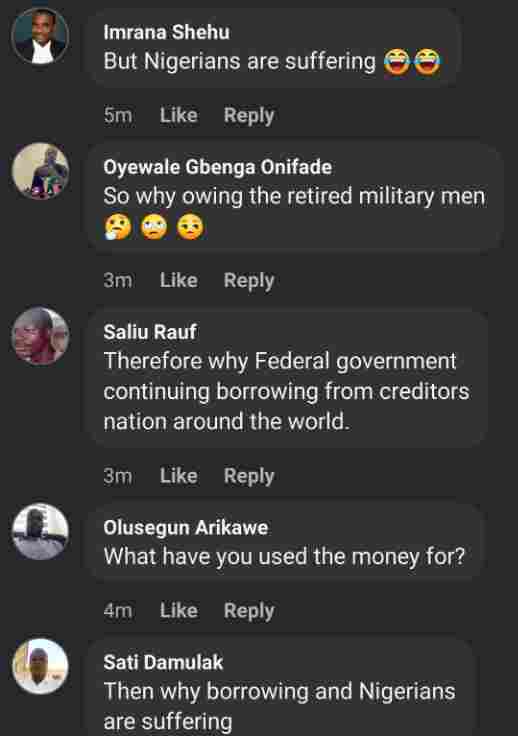
One social media user, Imrana Shehu, reacted by saying, “But Nigerians are suffering.”
Another commenter, Oyewale Gbenga Onifade, questioned why retired military personnel were still being owed despite the reported savings.
Salihu Rauf also asked why the country continues to borrow money from international creditors if trillions of naira have already been saved through subsidy removal.
Olusegun Arikawe raised concerns about transparency and accountability, asking what exactly the money had been used for.
Another Nigerian, Sati Damulak, echoed similar concerns, stating that borrowing and economic hardship should not continue if such large sums had been generated.
Haruna Abdulkadir Mohammed described the reported savings as having little visible impact on the lives of ordinary Nigerians.
Fabong Babangida Ishaya questioned why citizens were still struggling despite the reported increase in government resources.
One of the strongest reactions came from Ernest Sly, who argued that more of the funds should have been channelled into improving electricity supply across the country. According to him, stable electricity would help reduce production costs for businesses and improve economic activities.
Another commenter, Obakpolor Emmanuel, openly doubted the government’s explanation regarding the savings.
The reactions reflect a growing public debate over the benefits and impact of the fuel subsidy removal policy introduced by President Bola Ahmed Tinubu’s administration in May 2023.
For many Nigerians, the key question remains whether the economic reforms have translated into tangible improvements in their daily lives.
Meanwhile, Oyedele provided a breakdown of how the Federal Government spent its additional resources during the period.
According to him, the government recorded incremental expenditure of ₦30.64 trillion between June 2023 and December 2025.
He said ₦9.39 trillion was spent on wage adjustments, implementation of the new minimum wage, salary increases and allowances for public servants.
Another ₦9.37 trillion was used for external debt servicing obligations.
The government also spent ₦6.5 trillion on strategic infrastructure projects across the country.
Oyedele stressed that the amount spent on wages alone was greater than the Federal Government’s direct share of the subsidy savings.
He explained that the Federal Government received ₦5.4 trillion from subsidy removal but spent ₦9.39 trillion on higher wages and related payments.
The economist also addressed concerns about rising debt servicing costs.
According to him, the increase in debt servicing expenses was largely caused by the depreciation of the naira rather than an increase in the dollar value of the country’s foreign debt.
He explained that if Nigeria previously paid the equivalent of ₦460 for every dollar of debt service obligation and now pays around ₦1,415 per dollar, the government would naturally require more naira to settle the same debt obligations.
Oyedele maintained that debt servicing obligations cannot be delayed because failure to honour such commitments could have serious consequences for the country’s financial reputation and access to international funding.
He further stated that the reforms were not primarily introduced to increase government revenue but to address long-standing distortions and corruption associated with the fuel subsidy regime and the foreign exchange market.
The latest figures are likely to fuel further discussions among economists, business owners, investors and ordinary Nigerians about whether the gains from subsidy removal have been sufficient to offset the economic pain experienced since the policy was introduced.
For businesses, particularly small and medium-sized enterprises, the debate remains important because fuel prices, exchange rates, electricity costs and borrowing costs continue to have a direct impact on operations and profitability.
As conversations continue online, many Nigerians are demanding greater transparency on how subsidy savings are spent and clearer evidence of the benefits from the economic reforms.