I have had many conversations with people who were recently made redundant, and one question always comes up almost immediately. It usually comes with a bit of anxiety: “Prudent, will I be taxed on my redundancy pay?” That question is very important because the answer directly affects how much money you actually receive in your bank account.
The truth is, redundancy pay in the UK is not as straightforward as many people think. Some parts are tax-free, while others are fully taxable, and if you don’t understand how it works, you may either panic unnecessarily or expect more money than you’ll actually receive. Let me walk you through everything in a clear and practical way so you fully understand what applies to you.
The Simple Answer: Is Redundancy Pay Taxable?
Let me start with the direct answer.
Redundancy pay is partly tax-free in the UK, but not all of it.
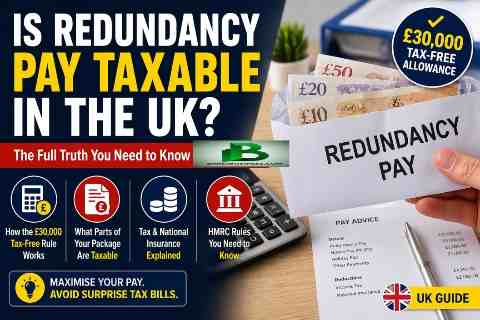
According to official guidance from the UK government, you do not pay tax on the first £30,000 of genuine redundancy pay.
That sounds simple, but this is where many people misunderstand things. What most people call “redundancy pay” is actually a bundle of different payments, and each one is treated differently for tax purposes.
What Is Included in a Redundancy Package?
When you are made redundant, your employer may give you what is called a termination payment. This can include several components such as:
- Statutory redundancy pay
- Holiday pay
- Unpaid wages
- Bonuses or commissions
- Pay in lieu of notice (PILON)
Each of these elements is treated differently when it comes to tax, and this is where things become very important.
From my experience, many people assume the entire payment is tax-free, which is not correct.
The £30,000 Tax-Free Rule Explained Properly
Let’s break down the most important rule.
In the UK, you usually do not pay income tax on the first £30,000 of redundancy compensation, including both statutory redundancy pay and any additional severance your employer gives you.
This is a major benefit and one of the reasons redundancy payments can feel like a financial cushion during a difficult time.
However, anything above £30,000 becomes taxable and is added to your income for that tax year.
So if you receive £40,000:
- First £30,000 → tax-free
- Remaining £10,000 → taxed as income
The Hidden Truth: Not Everything Counts Toward the £30,000
This is where many people get caught off guard.
Not every part of your redundancy package qualifies for the tax-free threshold. Some payments are treated as normal income from the beginning and are taxed fully, regardless of the £30,000 rule.
These include:
- Holiday pay
- Unpaid wages
- Bonuses
- Commission
- Payment in lieu of notice (PILON)
According to UK rules, these are treated as earnings, meaning you pay both income tax and National Insurance on them.
Related Content




From my experience, this is the exact reason why people feel their redundancy payment was “taxed too much.”
What Is Payment in Lieu of Notice (PILON)?
Let me explain this clearly because it confuses many people.
If your employer decides not to let you work your notice period, they may pay you instead. This is called Payment in Lieu of Notice (PILON).
Now here’s the key point:
PILON is always taxable.
It is treated exactly like your normal salary, which means:
- Income tax applies
- National Insurance applies
This rule changed in recent years to close loopholes, so there is no exception here.
Do You Pay National Insurance on Redundancy Pay?
This is another area where people get confused.
The good news is:
You do not pay employee National Insurance on genuine redundancy pay, even if it exceeds £30,000.
However:
- You still pay National Insurance on wages, holiday pay, and PILON
- Employers may pay certain contributions on amounts above £30,000
So again, the structure of your payment matters more than the total amount.
Real-Life Example (So You Fully Understand)
Let me break this down with a simple example.
Imagine you receive the following:
- £20,000 redundancy pay
- £5,000 holiday pay
- £5,000 notice pay
Total package = £30,000
Here’s what happens:
- £20,000 redundancy → tax-free
- £5,000 holiday pay → taxed
- £5,000 notice pay → taxed
Even though your total is £30,000, you still pay tax on £10,000 of it.
From experience, this is exactly where confusion happens.
What About Enhanced Redundancy Pay?
Some companies offer more than the statutory minimum. This is called enhanced redundancy pay.
The good news is:
Enhanced redundancy pay can still be included in the £30,000 tax-free allowance, as long as it qualifies as a termination payment.
But again, it must not be disguised as wages or bonuses.
Common Mistakes People Make
From what I’ve seen over time, these are the biggest mistakes people make:
- Assuming the entire payment is tax-free
- Not understanding the difference between redundancy pay and wages
- Ignoring PILON taxation
- Not checking their payslip properly
- Expecting more money than they actually receive
These mistakes can lead to serious disappointment.
Why You Might Feel Overtaxed
Many people come to me and say, “I think I was taxed too much.”
Most of the time, the issue is not over-taxation—it’s misunderstanding.
When your redundancy package includes:
- Notice pay
- Holiday pay
- Bonuses
Those parts are taxed normally, and that reduces your final payout.
From my experience, once people understand this breakdown, everything becomes clearer.
Can You Claim a Tax Refund?
Yes, in some cases.
If too much tax is deducted, you may be able to claim a refund from HMRC. This can happen if:
- You were placed on an emergency tax code
- You had no other income that year
- Your tax was calculated incorrectly
So it’s always worth checking your tax position after receiving your payment.
Honest Advice
Let me speak to you directly.
If you are facing redundancy or expecting a payment, do not focus only on the total amount. Instead, focus on the breakdown.
Ask your employer:
- What is redundancy pay?
- What is notice pay?
- What is taxable?
Because the structure matters more than the headline figure.
From my experience, people who understand this early make better financial decisions and avoid unnecessary stress.
Conclusion
So, is redundancy pay taxable in the UK?
Yes and no.
- The first £30,000 of genuine redundancy pay is usually tax-free
- But other parts of your package are fully taxable
Once you understand this, everything becomes clearer.
Redundancy can be a difficult experience, but understanding your finances during this period gives you control. And as I always say, it’s not just about how much you receive—it’s about how well you understand it.