Stock price discrepancies across Nigerian investment apps typically stem from differences in data refresh rates and reporting methods. Common causes include market data delays, variations between last traded and live prices, and the use of different data providers. These factors result in slightly different figures for the same security.
Licensed investment platforms generally do not manipulate market prices. Variations usually represent different moments in the trading session or the distinction between bid and ask prices. To ensure accuracy, investors should verify if an app provides real-time data and confirm the latest market activity before making financial decisions.
If you invest in Nigerian stocks or are just getting started, you may have noticed something confusing.
You open one investment app and see Access Holdings Plc trading at ₦22.00. Then you check another app at the same time, and it shows ₦22.70.
This raises an important question:
Which price is correct? Is one app adding or subtracting from the real market price?
This is a common concern among investors, and the answer is more straightforward than many people think.
The Question That Sparked the Discussion
Recently, a screenshot shared online compared two stock investment apps displaying different prices for the same Nigerian stocks.
One app showed Access Holdings Plc at ₦22.00, while another displayed ₦22.70. Similar differences could also be seen for other stocks.
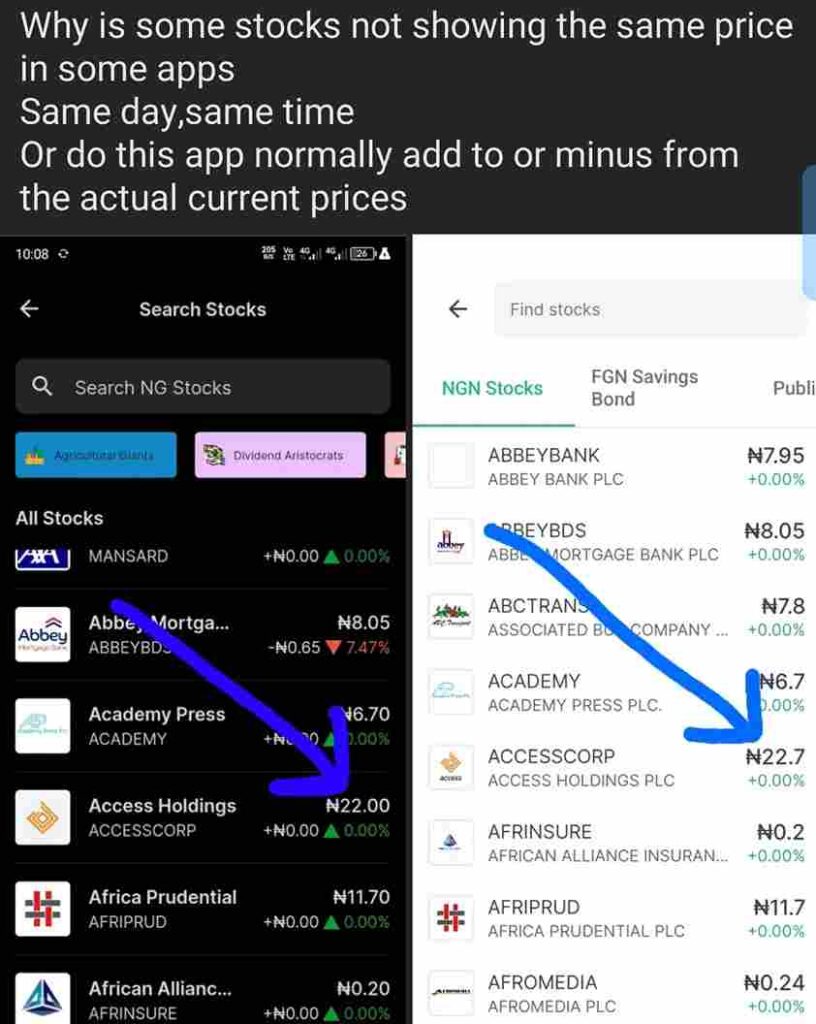
This left many investors wondering whether some investment apps manipulate stock prices.
The good news is that, in most cases, they do not.
Why Stock Prices Differ Across Apps
There are several reasons why the same stock may appear at different prices on different platforms.
1. Delayed Market Data
This is the most common reason.
Many investment apps do not display real-time prices. Instead, they may show prices that are delayed by 15 minutes, one hour, or even the previous trading day’s closing price.
Related Content




Some platforms pay for premium market data feeds that update instantly, while others rely on delayed information to reduce costs.
If one app updates every second and another updates every few minutes, you will likely see different prices.
2. One App Shows the Last Traded Price
Some apps display the last executed trade.
For example, if the last trade happened at ₦22.00, that price may remain on the screen until another transaction occurs.
Meanwhile, another app may already be displaying the latest market activity at ₦22.70.
Both prices may be correct—they simply represent different moments in the trading session.
3. Closing Price vs Live Market Price
Some platforms are designed primarily for research.
Instead of showing live prices, they display the previous day’s official closing price.
Another app may show today’s current trading price.
Unless you know which data the app is displaying, the difference can be confusing.
4. Different Data Providers
Investment apps obtain market information from different sources.
Some receive data directly from the Nigerian Exchange (NGX).
Others receive their information through third-party market data providers.
Because update speeds vary, prices may not always match exactly.
5. Bid Price and Ask Price
There is also a difference between:
- Bid Price – the highest price buyers are willing to pay.
- Ask Price – the lowest price sellers are willing to accept.
- Last Traded Price – the price at which the most recent transaction occurred.
If one app displays the bid price while another displays the last traded price, the numbers will naturally differ.
Does Any App Add Money to the Actual Stock Price?
Generally, no.
Licensed Nigerian investment platforms do not arbitrarily increase or reduce official stock prices.
The actual market price is determined by trading activity on the Nigerian Exchange.
However, some apps may include estimated prices, delayed data, or cached information before refreshing.
The important thing is to understand what price the app is showing.
How to Know the Actual Market Price
If you want the most accurate price, consider the following:
- Use an app that offers real-time NGX market data.
- Refresh the page before making investment decisions.
- Compare prices with your licensed stockbroker.
- Confirm whether the displayed price is the current trading price or the previous closing price.
Should You Be Worried?
Not necessarily.
Small differences between apps are normal and happen in stock markets around the world.
However, if you notice a very large price difference that continues for several hours, it may indicate:
- The app has not refreshed.
- There is a technical issue.
- The platform is displaying delayed market data.
Tips Before Buying Any Stock
Before placing an order:
- Always confirm the latest market price.
- Don’t rely on just one investment app.
- Check whether the app provides real-time or delayed quotes.
- Understand that stock prices change throughout the trading day.
Conclusion
Seeing different prices for the same stock on two apps can be surprising, especially for new investors. In most cases, the difference is not because one app is manipulating prices. It usually comes down to how often the app updates its data, the type of price being displayed, or the market data provider it uses.
If you’re actively buying or selling stocks, always verify that you’re looking at live market data. A few minutes’ delay can make a noticeable difference, particularly on days when the market is moving quickly.
As more Nigerians embrace digital investing, understanding how stock prices are displayed can help you make better-informed decisions and avoid unnecessary confusion.